

Apparently the design wasn’t quite as locked as I thought
Hey, Jamie here.
A couple of weeks ago I wrote about us sitting down, locking the design for Box Directive and setting ourselves a fairly hard rule that we were not going to keep changing things.
So naturally, this week has involved changing quite a fundamental part of how the game works…
The more Box Directive has progressed through development, the more I have started to realise that it is moving away from where it originally began. Early on, there was definitely more of a clicker / automation / numbers go up game underneath it. Pack boxes, earn money, improve things, repeat for long enough and eventually reset through a Prestige system to begin the climb again.
There is nothing wrong with that type of game, but as everything else has developed around it, it has started to feel less and less like the game we are actually making.
The game is becoming more detailed, the individual packing stages are becoming more involved, the corporate setting is giving us more opportunities for story, and systems like consumables, contracts, station upgrades, overflow system and eventually the robot are all giving the player more things to think about.
At some point I found myself looking at the gameplay loop and thinking that asking the player to essentially stay in that same loop for a long period of time before eventually resetting just did not really fit anymore.
So we started looking at shifts.
Breaking the game into shifts
The idea is fairly straightforward. Instead of one long continuous working session, Box Directive is now broken into individual working days.
At the moment, a Live Shift lasts five minutes. That number will obviously be something we test and balance properly once all of the systems are working together, but having a defined amount of time immediately changes how the game feels.
There is now a beginning, middle and end to each working day.
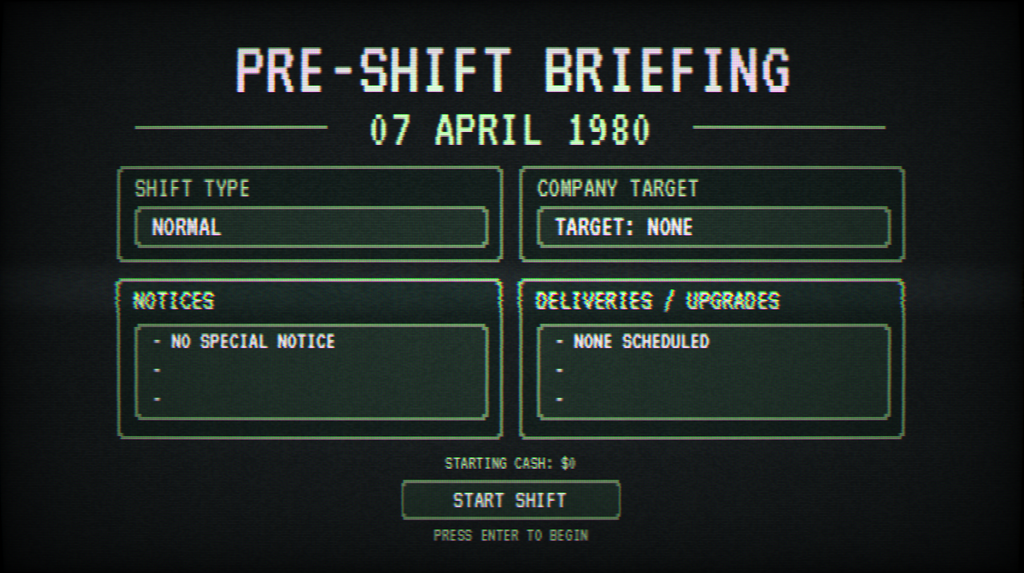
Before the clock starts, the player gets a Pre-Shift Briefing. This is a calm moment before anything starts moving, where we can tell the player what sort of shift they are about to walk into.
Is it a normal shift? Is there a Company Target? Are there any notices they need to know about? Have they got an upgrade or delivery coming? Has something happened in the story?
Some things will be shown up front and others, particularly certain events, can remain hidden until the shift actually begins.
Once the player starts the shift, the timer begins and they are back at the desk, and that timer suddenly gives all of the other systems a time cost.
If you want to open BoxOS and buy a station upgrade, you can, but the clock is still moving. If you are working towards a Company Target, maybe spending time elsewhere is not the best idea. If it is a normal shift with no particular pressure, perhaps you use that day to concentrate on something completely different.
It gives the player decisions to make rather than simply asking them to pack as quickly as possible forever.
Five minutes changes quite a lot
One of the things I like most about moving to shifts is how many of the other ideas we already had suddenly have somewhere much more natural to live.
We currently have four broad shift types planned: Normal, Company Target, Random Event and Story.
A Normal Shift can be relatively stress-free. There is no specific corporate target hanging over you, so you can concentrate on making money, improving things or whatever else makes sense at that point.
A Company Target Shift is different. You might be told that the company expects a certain number of boxes, a particular throughput or some other requirement. Hit it and there can be a benefit. Miss it and there may be a fairly hefty fine waiting for you at the end of the day.
Then we can start using Random Events and Story Shifts to change the rules again.
Audits become much more interesting when they happen on a defined day. Quality matters more when poor performance can come back to bite you at the end of a shift. Contracts can run across multiple working days. New features can unlock after a particular number of shifts, and story beats can be dropped in between everything else rather than waiting for the player to reach one enormous progression milestone.
It gives us much smaller chunks in which we can keep throwing something new at the player.
That is probably the biggest reason I think this change is going to work better. Just as the player starts getting comfortable with one part of Box Directive, we have another opportunity to introduce something else.
When the clock hits zero
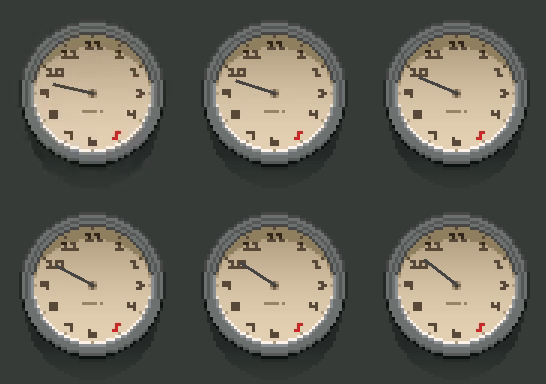
The five minute timer also raised the question of what happens if the player is halfway through a box when the shift ends. Simply cutting them off at zero felt a bit harsh, but allowing the shift to continue indefinitely would defeat the point of having the timer.
So if there is an active box when the clock reaches zero, the player gets up to 30 seconds of overtime to finish that one box. No new box can be started and, as soon as the active box is shipped, the shift ends. It is a small rule, but one that makes the end of the shift feel much fairer without removing the pressure of the clock.
Clocking off
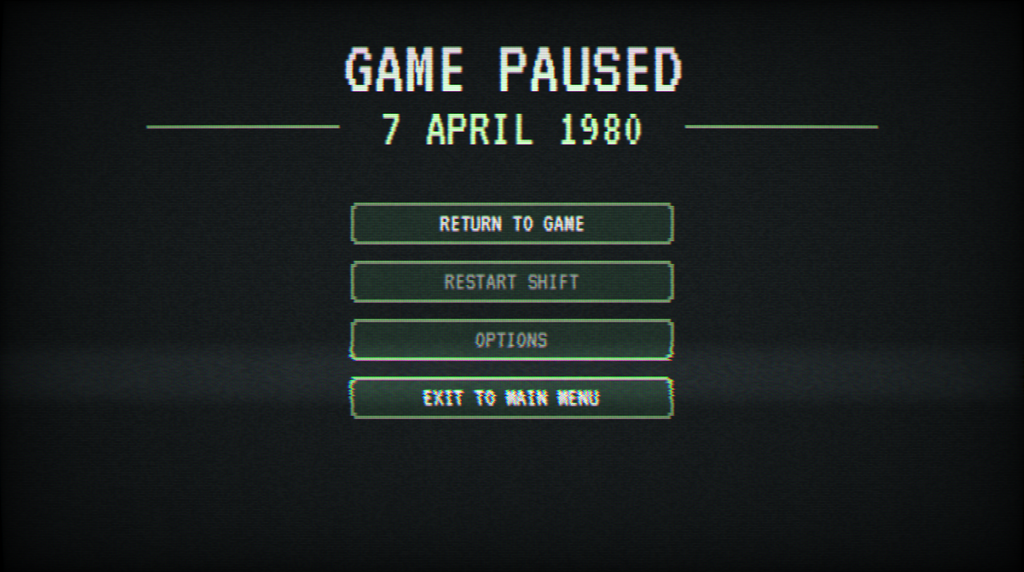
Once the shift is finished, the game now moves into the Post-Shift phase.
This is probably the most obviously placeholder-heavy screen in the whole system at the moment, but it shows where we are heading.
The idea is that this becomes the player’s summary of the working day.
How many boxes did you send? What was your average throughput? How was the quality? Did you pass your Company Target? How much money did the shift make? What did you spend? Were there any fines? What rewards have you earned and is there anything you need to know before tomorrow?
One fairly major change tied into this is that money no longer needs to feel like a constant stream appearing after every individual box. The end of a shift gives us a natural point to bring earnings and costs together.
That means you might have had what felt like a great five minutes packing boxes, only to discover that a failed Company Target, poor quality or other penalties have taken a chunk out of it.
Likewise, consumables and other spending are part of that overall picture.
It creates a much more interesting little risk/reward moment every few minutes rather than simply watching the cash number continually increase.
Station upgrades now fit into that structure as well.
Rather than buying an upgrade and having the workstation magically change in front of you, upgrades can be purchased while you are working and queued for installation overnight. The idea being that somebody on the night shift comes in once you have gone home and does the actual work.
When you arrive the following morning, the upgraded station is ready.
The same date system gives us a better way of dealing with things like future Robot parts. If something is being delivered on a particular date, we can tell the player that it is two working days away, then one day away, then finally that it is arriving today.
It is a small bit of structure, but it makes those things feel like they are happening inside an actual workplace rather than simply being another unlock bar filling somewhere in the background.
A better structure for Box Directive
The Shift System also changes how we can introduce the game to the player.
Rather than throwing the entire packing process at them immediately, the current plan is to use the first few shifts to gradually introduce the different stages. That gives us a tutorial which is built into the player’s first working days rather than one large tutorial dumped on them before the game really begins.
After that, other systems can start arriving at the points where they make sense.
Contracts, Overflow, station upgrades, new skills, corporate demands, events, emails and story developments can all be introduced as the player progresses through their working life at the company.
Some things will be tied to how many shifts have passed. Others will depend on what the player has earned or achieved behind the scenes. The important part is that we now have a structure that lets us control the pace.
If the game starts feeling a little too comfortable, we can change something.
And because a shift is only a short chunk of play, it also makes Box Directive much easier to dip in and out of. Play a couple of shifts, make some progress and stop. Come back later and you immediately know where you are: it is the start of another working day.
UP next
Back onto the packing stations for me next week. With the new shift system, came some revisions to the stations to make them much more interactive for the player.
I’ll also be dropping in some of the great new assets Andy has been working on. We can now see the scene starting to come together as more elements move out of blockout and into their first pass artwork.
Catch you next week!
Omg mad !
Mad indeed!